The Importance of Accessibility in Public Sector Design

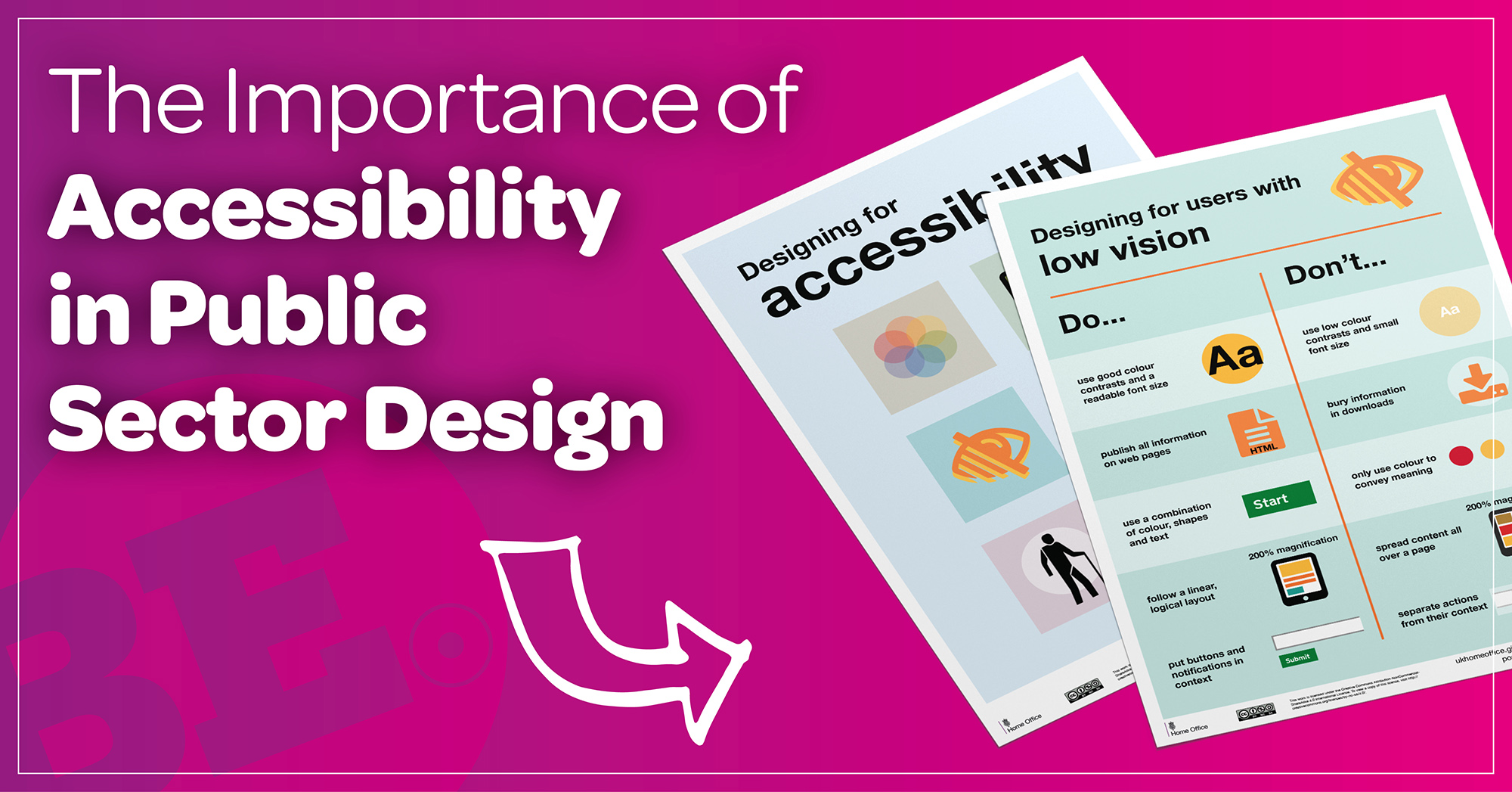
Image showing examples of accessibility in design

We now live in a world where we can (and increasingly do) make and create things that are accessible to as many people as possible. Anything manufactured goes through certain standards and even light switches and plug points in new build homes must be fitted at a specific height.

This is also possible, and indeed sensible, with design.

The design of websites and content can be accessible. Accessibility in design might not be on your radar right now, but in many sectors, it is now or will be soon.

Is there a legal duty to make websites accessible?

Not yet – but it’s coming…

A standard requirement for websites in the UK moves us all towards an online world that is as accessible to all as the real-life world aims to be.

“Public sector organisations have a legal duty to make websites accessible.”

For now, it’s only the public sector that is governed by law to make website more accessible, but it’s worth reading on if you’re in the private sector as it highly likely to follow eventually… and it just makes sense when you consider it all.

At least 2.2B people globally are classed as visually impaired, and there are many others who can’t read or who don’t have English as their first language. Building and designing for them isn’t just a nice to have – it’s a huge market you need to consider.

You should also pay special attention to these tips if your main audience are over 50, as they’re statistically more likely to be visually impaired.

Balancing design with accessibility

The big challenge here is getting it right for as many people as possible. And one area we’re keen to express an importance on is design (for obvious reasons!). You can have a beautiful website with great UX and make it accessible; you just need to plan it carefully.

It can be very difficult to balance these legal requirements when it comes to design and making things work, but it is possible.

Some areas to consider are:

  • Choose colour hues, contrasts, font sizes, and font weights that meet AA compliance.
  • Avoid using colour hues at the ends of the spectrum and instead go for a happy place between dark and light.
  • Oh… and make sure background colours aren’t too faint. To be honest, avoid this anyway as even those with great eyesight will have to work harder to see it.

What about ALT Text?

ALT text (alternative text) is a small description of the image that you place in the code of your image – usually via your website’s Content Management System (CMS) – to describe the image to the visually impaired.

By using the ALT text option on your images religiously you ensure your website is now more accessible to people who have a visual impairment. In addition, good alt text also helps improve your site’s search optimisation (SEO). Here are some great tips on using ALT text to increase your SEO. Google images, for example, uses the ALT text and image title to determine where the image appears in the search results.

The limit on ALT text is around 140 characters yet needs to be detailed enough to explain all areas of the design. It’s a real artform to get it right.

Social media

Social media is another place to consider accessibility. Social posts come up as ‘decorative images’ when they contain both image and text to someone with a visual impairment. No other information can be read.

Important text needs to be on the post; not on graphics because they can’t always be successfully read by those in need of accessibility assistance.

Many scheduling tools or social media sites won’t include any prompts to add alt text either. Again, this may change soon. LinkedIn has recently started prompting for ALT text on images so be sure to use this option when you can.

Don’t hide your messages in the design

Important text needs to be on the page; not just on the graphics. Text on images can’t be successfully read by people who are visually impaired.

It’s common in web design for key messages to be in graphics or banners but unless those are places that house your heading 1 or heading 2,3,4 titles then it’s possible that you’re keeping all the best information to those with 20:20 vision and alienating a large section of your visitors.

Death of the infographic?

This is a huge issue. The popular infographic is fairly useless when you consider all the above, isn’t it?

This new design rule could have a knock-on effect on posters too. If you’re reliant on designed downloadable PDFs, slides, infographics, or similar then it’s time to have a re-think. Here at Be Smart we’re up-to-date with the latest thinking on this, so can help you to find creative alternatives. We recommend you start looking now.

This is a good thing. You’ll reach and help more people and more of us will be able to read about you. So don’t see this as a challenge – see it as an opportunity!

We work with many public sector clients and have a brilliant understanding of how you work and how design works for you and your audiences. Get in touch and let’s chat about accessibility in design – or anything else you’d like to discuss.

Logo Design Trends and Designs to Avoid

“Can we make the logo bigger?”

If you’ve ever spoken to a designer they’ll tell you that this is one of the most commonly requested and frustrating questions.

*And… breathe…*

Perhaps there’s another way.

We could indeed make the logo bigger, but why don’t we also look at making it right for you?

A logo is one part of your brand – and at no point should you forget that – but in this blog we’re going to look at logo design trends to avoid.

Why should you avoid these? Because if you don’t, they’re going to stop your brand from being the best it can be. Some of these things will make your brand look clunky, cheap, boring, and everything in between.

So here we go then… a long list of logo design trends to avoid. Let’s dive in…

3D logos

In short, this is a design trend that went out with baggy jeans and Oasis. I know, it’s a shame, but we have to move on. In the 90s and into the 2000s the 3D logo was a thing – a big thing. But because it’s “So 90’s” it’ll instantly date your brand if you go near it. So just don’t.

Embossed logos

Although these logos work well on workwear and other clothing, an embossed logo won’t look so good on your website and social media. A logo needs to work across the board – on all platforms – so choosing a logo with heavy gradients or drop shadows is to be avoided. This is now a big deal as your logo isn’t just for print, TV, or products like Coke in the 1950s. Your logo needs to work in many settings and on a variety of materials.

Fashionable fonts

Fonts can come in and out of fashion, and you need to be aware of this. Choosing something timely (in the mid-to-late 80s people were obsessed with Black Gothic) can be a good and bad thing. Fashions come and go and that’s the same with your logo.

Think how many times Amazon and Apple have updated their logos and the fonts that went with them. (By the way, the major brands often update their logos with small, simple, and elegant changes.) Choose a font that’s on trend now or go for one that’s from way way back (that isn’t 80’s, 90’s or 2000’s by the way) as it’s likely to be retro rather than trendy, and that could last a lot longer in terms of staying relevant.

Don’t over-complicate it – simplicity is best

Keep It Simple, Stupid (KISS) is a mantra to live by when it comes to design. Over-complicating your logo is a recipe for disaster. Go for a flat design as this works well across a multitude of platforms and places – and don’t overdo it on the number of colours used, either.

Don’t create a logo in six colours

Sure, you can have a palate for your brand guidelines, but you don’t need to use them all in your logo!

*And breathe again…*

A logo with lots of colours is a pain for print, looks crap on clothing, rubbish on your website, and when you consider email, social, banners and more it just makes things very hard to look good. Simplicity is best. Stick to 2-3 colours at most. There’s a reason most of the biggest brands in the world have just two colours in their logo. Less is most definitely more.

Colour contrast

You also need to make sure the design works in black and white. We recommend a light and dark variation. This will come in handy for email footers or landing pages where you need a lighter version of your logo. It’s also especially useful when your brand is used in partnership with another brand or placed somewhere where your original brand colours might clash.

Think about where your logo is going to be used

This. Is. HUGE! Please consider all of the places your logo will go. Then add possible future plans to the list. You may not have a fleet of vehicles yet, but what happens if you get them in 3 years’ time?

Here’s a little list to jog your memory:

  • Websites
  • Social media
  • Email marketing
  • Email footers
  • Brochures
  • Leaflets
  • Business cards
  • Roller banner
  • Exhibition stand
  • Vehicles
  • Buildings
  • Walls
  • Floormats
  • Mugs
  • Magnets
  • Case studies
  • Portfolios
  • Clients’ websites
  • Clothing
  • Accessories
  • Expo giveaways
  • Client gifts

… we could go on.

Think about your business, and then put all the places you use your logo into a list when you work with your branding agency and logo designer. It must work in all places. Sure, you can have some different versions, but this needs planning at the start before you consider the design and definitely before you sign it off!

Your logo must work in portrait and landscape

It’s a simple one this, but worth mentioning. Your logo will need to go in a lot of places as we’ve mentioned already. But remember that it’ll need to be visible and clear in landscape for events and online marketing banners, and in portrait on social media, apps etc. Even social media apps vary! Headings on LinkedIn are very different from Instagram posts in terms of sizes and therefore design. Create your logo with both in mind as who knows where you’ll need to put your logo in the future.

Think about font colours

Do the colours work on a website? Are they readable on business cards, uniforms, or leaflets? We often suggest avoiding yellow if you can as it looks awful on websites. And think about vehicle graphics and the vehicle colours you have.

It’s always best to build a list of where your logo will go and work back. Font colours are arguably more important than the logo as you’ll use them to convey important messages.

Font styles need to match the business

A font says something about you. It does. And not just to font geeks like us – to everyone. A Times Roman to one is a Sans Serif to another. And please… avoid Comic Sans unless your target audience is primary school children, OK?

However, if the business suits the font (such as serif) as they’re seen as traditional, then this works well too. Some brands will choose a traditional font as it gives them a look and feel of the past which in turn helps you to see their heritage and thus their expertise and trust.

Logos go places (if you let them!)

The biggest message from this blog is this:

A logo will appear in more places than you realise. Get thinking and writing down the places you’ll need your logo to perform.

Yes, we said perform. It’s time to stop ‘sticking your logo’ anywhere you need or want to. Design one that suits the places it’s put – and is going to be put – and help it generate you the right brand awareness… sales… and more.

Need help designing your next brand and logo? Some and say hello to the team. We’ll chat fonts and stylesheets over a cuppa. We’ll listen to your ideas and work together to create a logo that ticks all the boxes.

Why Does Design Work Take Time?

Waiting for stuff is hard, isn’t it?

It’s even harder when you’re having to rely on others to make something a reality.

This is particularly the case when you’re waiting on a design for your business. Whether it’s a logo, website, or rebrand, the wait time can feel like forever.

However, just like everything that’s good in life, the wait is always worth it.

There are five stages every design needs to pass through if it’s to be as good as it should be.


Stage 1: Research

What’s the reason behind the design? More importantly, who are you attempting to put it in front of?

Without research, a design is just a drawing with no purpose, strategy, or value. That’s why this is arguably the most important stage of the process. It’s the opportunity to define a goal for the design and dig into the audience.

What are they likely to be attracted to? What will make them act? What are they used to seeing in your niche? What other designs are out there already that work (or don’t work)?

Research is vital in design, and it might be the longest, hardest stage of the process.


Stage 2: The brief

This is where so many design projects fall down. Rather than researching first (or at all), people will often jump straight into the brief.

Let’s sit down. Have a coffee. Chat it through.

But what if you don’t know what you need or why you need it?

Return to Stage 1, if that’s the case.

Assuming you’ve followed our advice thus far, you’ll have that research in hand. And that means you can begin briefing the design studio.

They should guide you through this stage and if they’re anything like us we’ll sweetly challenge you on it. Expect many, many questions. Again, this part of the process takes time. (Conversely, if you get this right, it might even make the design process shorter).


Stage 3: Design Concepts

This is where things start to get exciting, because it’ll provide a first glimpse of the design.

Concepts aren’t as rough as you might think, either. In fact, this is one of the most exciting parts of the process, because if you work with the right branding team, you’ll receive designs you might expect along with some far braver, off-the-wall options, too!

At this stage, it’s tempting to pick your favourite and ask the team to crack on.

Don’t. Hold your horses.

Sleep on it and run those designs past other stakeholders within the business. If you can, pitch them to clients, too. Ask people you think might be your target audience. Your neighbour doesn’t have to like it if they’re not who you’re selling to! Gather as much feedback as you can.

Beautiful concept designs are a double-edged sword. They can force you into thinking that you’re looking at a finished design when, in fact, you’re simply being wowed by a pretty new thing.

The trick here is to go back to your original research and brief. Which of the designs most closely matches the goal and essence of what you’re try to achieve?

Trust us – these concepts will need tweaking and the design agency will fully expect you to return with questions and suggested improvements. They’re not finished by a long shot.

Leave no stone unturned. Again, this takes time.


Stage 4: Development

This is it; time to refine, polish, and aim for perfection.

It’s also the time when things go a bit quiet. Too quiet, you might think.

You’ll worry that the design agency has had its head turned by another, more exciting project. You’ll feel compelled to chase them every day.

Don’t.

Despite the seeming completeness of those concepts, the team will still have lots of work to do, following your feedback.

Trust the process. Leave them to it. They’ll contact you when the finished designs are ready.

But, hold your horses – we’re not quite finished.

The development stage is when those final polishes are undertaken. It’s why you’ll need to closely study the final designs that have been sent over and reveal where they’re not quite final enough for you.

Don’t hold back. If you’re still not completely happy, now’s the time to reveal why, because once the design is committed to its various formats and destinations, there’s no turning back.

Time spent on this time now will save a huge amount of heartache and remorse further down the line.


Stage 5: Sign-off

Yay – the hard work is done!

But this doesn’t mean you simply wait for the artwork files to arrive and dance into the sunset. There’s still lots to do.

Firstly, those image formats will need creating, sharing, and ensuring you’re familiar with how to use them. This takes time.

The designs will also need implementing. This takes a lot of time.

For instance, if the new design is a logo, just think about how many places in which it’ll need to appear. Whether they’re physical, digital, or both, this is arguably one of the longest processes you’ll need to go through. We can help with this if you need it.

So, you’re not quite there yet. But the finish line is in sight.

Great design takes time, but it is always worth the wait. To find out more or to discuss your branding requirements, just get in touch with the Be Smart team, today.

Protecting Your Brand Assets: 7 Common Mistakes

If you have a brand, you need to protect its visual assets.

That sounds simple, right? But we see the same mistakes over and over again.

That’s why we decided to break down the most common mistakes we encounter when it comes to brand assets so you can avoid slipping on similar banana skins yourself.

This might not be the most scintillating blog post we’ve ever written, but it’ll be one of the most valuable you’ll read this year. So, listen up!


MISTAKE 1: Losing original design files

We frequently work with clients who don’t have access to the original design files for their logos, wordmarks, and other key assets.

This is annoying. For everyone.

Make sure you keep the InDesign, Photoshop, or Illustrator files from the initial design process as well as high quality exports of each design asset – and keep plenty of backups, too!


MISTAKE 2: Losing high resolution image files

It really is a good idea to retain image files in their original formats and in the highest resolution or file size possible.

Because we can guarantee you’ll be asked for them at some stage.

This is true for photography as well. Be sure to keep the highest resolution image (sometimes referred to as the ‘raw’ file), even if you need to resize and save smaller versions of an image.


MISTAKE 3: Accidentally altering original design files

What if, one day in the future, you decide to revive an old logo or wordmark? Sprinkle it with your brand’s new design language, maybe? Or revise the font choice, perhaps?

To ensure you can do this, be sure to duplicate any original design file you receive and save a new version and version control it with a numbering/date system.

Otherwise, you could end up permanently altering one of your most valuable assets. Not a good idea – trust us.


MISTAKE 4: Forgetting to keep EPS versions of large print assets

The term ‘EPS’ stands for Encapsulated PostScript, and it is a vector graphic of your design.

These are small, scalable, and editable images made up of geometric shapes that can be printed in high resolution and on any scale of your choosing. They’re invaluable, and you really don’t want to lose them.

If you don’t keep EPS versions of large print pieces, you may not be able to print a sharp, clear image on a large scale, and that could seriously hamper your marketing projects.


MISTAKE 5: Using the wrong file format (PNG v. JPG!)

The term ‘PNG’ stands for Portable Graphics Format and relates to a raster-graphics format that supports lossless data compression. You can make the background of PNG images transparent, which is useful for a huge number of scenarios including social media graphics and video work.

The term ‘JPG’ relates to a form of compression used on digital images to reduce their file size. You’ll come across JPG images most frequently in photography.

Whenever possible, save your design files and images as PNG and also as JPG. It’s great to have both to hand.


MISTAKE 6: Using colours that are almost your brand colours… but not quite

To retain your original brand colours, you’ll need to store notes about the exact Pantone, CMYK, HEX, or RGB breakdowns used.

When you pull those colours into design projects, the Pantone, CMYK, HEX, or RGB breakdowns will be essential, and every single designer on the planet will ask for them.

Make sure you know these breakdowns! Guesswork is never okay and will lead to inaccuracies and inconsistencies.


MISTAKE 7: Being totally disorganised with file storage

If all of these files are so important, where should they be kept?

Choose a location where every member of your team can access them, such as Dropbox or Google Drive. If your company or team is very small and only a couple of people require access, keep the original files with a senior owner. Your designer should certainly have copies, but the designer should not be the only one who has the files.

Oh, and always keep a backup in a separate location, and then backup the backup. You cannot have too many backups.

Make sure your files are easy to access too. Work from the same design in the same place each time and keep track of versions. Maintaining this way of working is the only way to ensure consistency in design across your brand’s assets.


Need branding help? Get in touch with the Be Smart team, today!

Be Smart – What Should Your Annual Report Include?

At its most basic (and boring), an annual report is a gathering of information that tells the story of your business.

It provides a detailed account of how well the company has done in the previous year, for the shareholders and other interested parties.

It’s also a legal requirement but that doesn’t mean it has to be rigid or intimidating.

Your annual report can instead be a great story which tells the tale of how far the business has come, and the number of bumps it encountered on the road.

Approaching your annual report as a story will breathe life into your data and make it come to life.


Make it fun and interesting!

The approach to annual reports has changed over the years.

Rather than the dry, boring print reports of the past, there are now a plethora of exciting and engaging ways to tell your brand’s story.

The goal of an annual report is to highlight your company’s accomplishments in a meaningful way. The format you choose will most likely be influenced by your target audience as much as it is the product, service, or mission of your company.

It’s vital that you choose the right format for your report. This could be the standard print version, or you can explore other avenues with digital and interactive versions.

You could even make a video.

This is a great way to get people to engage with the information (we all know that numbers on their own can be boring!).

This is where the design aspect takes control.


Captivate and sell through design

It’s important to sit down and work out a ‘theme’ for the document rather than just create a standard annual report.

Start by asking yourself a few questions.

  • What’s happened in the last year?
  • What’s coming up in the next year?
  • What do you want people to know about your organisation?
  • What do you want them to DO after reading the report?

Take these questions and create engaging visuals and designs. (Or ask a quality design agency to do it for you!) The visuals will help to engage your audience and enhance the information.

Instead of it being a dull presentation, the design you choose will have a great impact on how the numbers and data is received. The viewer’s interpretation of the data will be influenced by the images, photos, colours, and any other visuals you use – they’ll feel the report, rather than simply read it.


The basics to include in your annual report

Once you’ve gathered and structured the information for your report, you can turn it into something more creative and innovative.

The start of the report is an opportunity to highlight the company’s mission statement and values.

This is where the story begins, and we’ve got two tips for making it leap off the page.

  1. Start with a letter from the Chair or company founder. Paint the picture of why you started, and how you got to where the company is today.
  2. Write about the vision for the business and an overview of all the investors, directors, and the products that generate revenue.

Oh, and don’t forget to nod towards your competitors; it’s important to establish who those people are, right from the start.


Humanise the data

This is your chance to keep hold of your audience’s attention.

Ignore the temptation to simply slap a bunch of graphs and numbers onto the page. Instead, explain them – reveal how they paint a picture or tell a story. Indicate why you’re sharing the data and what it means to people.

Be honest and give real examples that reflect what is working – and what isn’t.

Focus your efforts on the sales, profit margins, and revenue over the last year. New products, employees, and any changes regarding sales will also add to the narrative.

The balance sheet, cash flow statement, income statement, and statement to shareholders are among the details that will also need to be present, but don’t lose yourself in the numbers. Start with an introduction that explains why they matter and why the reader should care.

Annual reports aren’t easy to create. They have to be comprehensive, data-rich, and yet completely engaging. If you fail with the latter, it won’t be read by anyone – it’s that simple.

Branding plays a huge role in the best annual reports, so why not get in touch with the Be Smart team to find out how we can make yours come alive?

Please Don’t Rush the Creative Process When Creating Your Brand Identity

If there’s one bunch of workers who are particularly used to tight schedules, it’s those of us who operate within the creative space.

“We’d like our new logo yesterday, please,” is what a lot of clients might as well say, such is the speed with which they want their shiny new thing.

The problem is that you really don’t want to rush creative endeavours such as branding. The result is rushed ideas which get in the way of concepts that’ll never see the light of day, simply because they weren’t given enough time.

Here’s why you need to stop underestimating the time it takes to build a successful brand.


How long does branding take?

Do you want to be a pioneer or a follower? If it’s the latter, your brand can arguably be created pretty quickly.

But then, you’re simply capitalising on an existing product or trend, and that probably isn’t as sustainable – or exciting – as being a pioneer.

This is why people usually underestimate the time it takes to build a brand. They see something they like, and assume their own version of that logo, strap line, or website can emerge quickly.

They did it… why can’t we?

But there’s so much more that goes into creating a brand, and it all takes time.


How do you create a brand?

When businesses reach the creative phase of a branding project, they often think those tasked with the design simply hit the computer and ‘create’.

But there’s so much more to do before we get to that stage.

In fact, jumping straight onto the computer is the worst thing you can do during a branding project, because you’ll have absolutely nothing to go on other than a hunch or desire to copy someone or something else.


It starts with the competition

If you want to beat the competition at branding, you need to look at what they’re doing, first.

Simply dismissing their branding as “rubbish” isn’t good enough; which opportunities have they missed, exactly? What is it about their logo, colour palette, or website which jars? What have they got right?

Competitor analysis should take a long time – even if you only have one competitor. Assuming you can simply do betterwon’t get you very far at all.


Finding white space for your brand

Most creative projects take inspiration from elsewhere, but they don’t simply copy what’s already out there.

Think about it: if your brand identity is simply a “better version” (that’s subjective, anyway) of your competitor’s, how will you stand out? To onlookers, you may even be indistinguishable.

This is why it’s important to find the white space for your brand. It’s there, somewhere, and with the right branding, you’ll leap into – and out – of it.

That white space must enable you to stand out, but it must also fit – it needs to suit your business. Finding it isn’t a quick task but it’s a much more important one than creating a pretty logo.


Creativity creep: it’s OK!

We’ve all heard about scope and mission creep – they set projects wildly off course and needlessly increase delivery times.

But there’s one type of creep that’s OK: creativity creep.

Things change. New stuff is discovered. Sometimes, an entirely new route appears during the creative process which clearly needs to be followed.

Remember that white space your brand needs to sit within? Sometimes, it’s only discovered halfway through the project (that’s how hidden it often is), and when that happens, it’s important to follow your intuition and your nose.

This is creativity at work and it’s why it takes time.


Is it possible to gain a solid end date for a creative project?

No, it isn’t.

Let’s not beat around the bush – anyone who gives you a definitive end date for a creative project will either miss it or deliver something that isn’t worth the money you’ve paid.

Understanding how a branding process, for instance, will pan out, is incredibly difficult. This is the nature of creativity; new avenues can present themselves without warning.

Designers are a passionate bunch, but that’s what makes them so good at their craft. It’s also why we all have to concede that they’re not fond of being pushed.

Push a creative to do something more quickly, and you’ll receive a poor finished result. And that’s because they won’t have the time to explore the avenues that are likely to suit your business and place it within that all-important white space.

So, if you need a new logo, video or marketing campaign – don’t rush it or those undertaking it! The secret to great creative work really is… timing.

Need help with your creative project and want to avoid the perils of rushing? Get in touch with the Be Smart team, today.

Bottling the lockdown creativity

PIVOT! If you’re a fan of iconic US sitcom Friends then the word ‘pivot’ probably conjures up an image of Ross handling a sofa up a stairwell.

More recently, the word ‘pivot’ most likely makes you think about businesses adapting or creating new offerings to move with the huge global change that lockdowns across the world have brought over the last few months

The world has erupted with ‘pivoting businesses’ and although the phrase is somewhat done to death now, you know what we mean when we say it. The positive thing about all this adaptation is that it’s pushed complacent businesses to make some changes.

It hasn’t just been SMEs which have had to scramble to make swift changes. Nearly all of us had to get used to remote working, online sales, and video meetings, including all the large corporates.

But with all this change and the 100s of 1000s of new offerings added into the mix, we started thinking;

“Wouldn’t it be great if you could bottle that lockdown creativity?”


Our backs to the wall…

A forced change can be a good change. For many businesses, and certainly the ones we’re talking to, they’ve finally got themselves properly online or added in that new IT infrastructure they kept meaning to arrange. The lockdown has moved the deadline to ‘now’ from the ‘never never’ list it had been on for years!

Those things languishing on the ‘online packages to do’ list got focused on, the marketing and branding suddenly came under the spotlight and lots of businesses were forced to be more creative than they were when they were comfortable.

It’s easy to become comfortable. Heck, we’re looking forward to a ‘comfort ledge’ after all this climbing, right? But we can’t stay there if we’re to improve and build on the businesses and organisations we’ve created.

What we really need to do is remember these times, and once a year, pretend we’re locked down and facing a global crash!


What you learn when you hit the canvas…

They say it’s not what you learn when you’re winning that counts, but when you lose. In every failure is a lesson, in every defeat is a learning to guide you in your next fight.

“It’s not how many times you get knocked down that count, it’s how many times you get back up.”

George A. Custer U.S. MILITARY

This virus was a battle. Even the politicians described it as such. We’ve all been battling, and in those battles we’ve been tested. Our business had to come out fighting, and in that fightback we learned new moves, new strategies, and even changed our shorts a few times!

It’s been tough… but we’ve learned a lot.

Imagine what you’ve learned in the past few months. Imagine learning and adding that to your business, brand, and marketing each year?


Recessions offer huge opportunity…

It’s well known in the business world that in a global recession lies a lot of opportunity and in this digital world – online now more than ever – it really pays to get serious about your brand and identity.

With the lack of ‘real life’ the internet has seen a huge increase in activity and those who took it seriously knew that this meant that their online marketing, social media, website, and content really mattered.

During a recession the best thing to do is go for it. Go loud, be proud, and shout your message from the roof tops (on brand, of course!).


Bottling the lockdown creativity…

You can create that lockdown feeling by planning ahead, setting large goals and building a brand that’s big enough and serious enough to complete those goals. Think about all the small challenges you had before lockdown and how you dealt (or didn’t deal) with them. It’s likely that because they didn’t post an immediate threat, other things that did took over.

During lockdown we’ve seen eCommerce side line projects be created in months and online offerings being created seemingly out of nowhere. You can do it when you have to. You can do it when you don’t fall prey to Parkinson’s Law.

Parkinson’s Law – work expands to fill the time available for its completion – meaning that if you give yourself a week to complete a two hour task, then (psychologically speaking) the task will increase in complexity and become more daunting so as to fill that week.

Ready to take that lockdown motivation and apply it to your brand or website? Give us a call or drop us an email now.

We’ll show you how you can take that inspiration from these pressurised times and explode it into the world!

How to make your brand stand out from your competition

We were all born to be different, so why fit in?

A company, business, product, or service needs to be unique and offer something that no one else in their niche does.

Standing out is the new blending in. In fact – standing out has always been important.

When you look back at some of the most important things to have been created and brought to the world in just our lifetime, you’ll find at the centre someone, or some company that refused to follow the status quo.

Standing out is one of the most important parts of your business or organisation and your brand is at the centre of it all, wrapped around you, your values, and what you stand for.

Standing out is more than just a snazzy tagline though…


Your values

Being yourself is a rule for life. In fact, it’s one of Arnold Schwarzenegger’s tips for success – “Trust yourself”.

Being you and building a company or organisation around the values that you stand for are important. Actually, they’re damn sure the only thing you should do. If you don’t do that, then you become beige.

(No one likes beige!)

Your values can stem from what you think about your industry or niche or how you want to make changes in the way things are done.

There are so many examples of this being done well in our society from Virgin with their fun, party-like style which runs deep from the early days of Branson’s magazine publishing, to Ben & Jerry’s who care deeply about everyone in the supply chain from supplier to consumer.


Tone of voice

Once you’ve sorted yourself out and allowed the values to shine through, it’s time to set that all-important tone of voice.

How you say something is how you say anything. From answering the phone to the billboard ads and social media posts; your tone of voice matters.

This can be set by what you absolutely don’t say to the words and phrases that you align yourself to. Blogs, web pages, adverts, video text and interviews can then all be led by this.

Tone of voice goes deeper than copywriting, too. If you’re creating content for podcasts and YouTube (even if you’re appearing on channels) then the words you use, the opinions you have, the topics you discuss are all important to your brand.

You wouldn’t see Nike advertising at a wedding show.


Palette

Colours are a big part of your brand. You don’t need telling that, do you? Your brand should have a palette that you can use in content, marketing and more. Your colour palette will have been chosen as they complement each other. That way, when you create marketing material, slide decks, social media graphics or YouTube idents, it all looks purposeful. You will more than likely have a primary colour palette for your logo and a supporting colour secondary palette for the look and feel of wider marketing material. If you don’t already have this, it’s worth having a chat with your designer.

A good brand will have brand guidelines, and these will stipulate which colours are used and often where they’re used. You might have different colour logos, but they’re to be used in the right places. It’s done on purpose, not just because it looks good on the brand guidelines PDF! You’ll possibly have different colours depending on the format, so you’ll probably need a black and white version, a reversed-out version, and versions with different colour backgrounds, etc.


Typography

Just as your colour palette determines your colours, your brand guidelines will also guide you on the typography you use, too. And, as above, there will be type faces and fonts decided for use in certain places and situations.

Headings and paragraphs are often different but work hand-in-hand thanks to good branding.


Your images

This is often overlooked but it really shouldn’t be. Ask any photography fanatic and they’ll tell you about their style and their inspirations. Photographers take pictures in a certain way and therefore they have a brand within that. The way they shoot is the way you view them.

Your brand needs photography that reflects the brand and the values it stands for. Just look at any large brand online and their website photography is a core part of their brand and it’s consistent across the board.

Apple always display their products with a stark white, almost clinical style and EE are consistent in their pictures of middle class, trendy, forward-thinking and busy people with their iconic white bubble symbols laid over the images.


Your marketing and content

And then it all comes together. Your values, tone of voice, colour palette, typography, and images all come together, on-brand and on-message and help you create the message for your marketing, perfectly. Every time.

Marketing needs to be on point and your brand guidelines and brand values will drive this. No matter what you’re creating and what it’s for, your brand will then guide your message so (if you’ve done it well) your message will stand out.

Marketing needs to stand out. So much marketing doesn’t because it’s not following the brand ‘rules’, or they simply never had them in the first place. Either that or it’s inconsistent… or the message is just crap!

A modern business or organisation creates a lot of content. From simple email footers to full-blown campaigns, there are so many elements to consider. Your brand should guide each and every part of this if your message is to land.

It will not only help it stand out if you’ve really followed your beliefs, but it will become consistent and that helps the consumers of your content neatly (and unconsciously) knit all your messages together and recognise you instantly no matter where they see you.


Branding shouldn’t blend in and neither should you or your message…

Looking to get your message out there? Want to make a real impact? Let’s have a chat. Book a call now with our head honcho, Philippa Smart, and we’ll see what we can do about getting your brand noticed.

Using storytelling in your company reports and briefings is a must!

Email subject: Can we talk about the annual board meeting later this week?

Your internal response: Argggh!


You know exactly what this is about. You’ve got to create the annual report for the important board meeting next month, and you’ll then need to circulate it around the departments afterwards.

You’ve been working on it for six months because you know that the earlier you plan, the more engaging the document becomes, and want to avoid a ‘thrown together at the last minute mess’!

But the blood runs from your face, you feel uneasy in your chair, and you start to sense that dread in the pit of your stomach.

“No one likes the annual report!”you say to yourself as you read the email.

“It’s boring and often the butt of jokes in the departments long after the meeting.”

But there’s a very good reason for that. That reason could be your salvation, so before you panic, allow us to tell you about it…


“Stories are just data with a soul…”

All of the top 10 TED Talks start with a story and in her incredible Ted Talk “The Power of Vulnerability”, BrenéBrown starts her talk with a story.

We particularly like the line “Stories are just data with soul…”as it perfectly sums up why your reports need storytelling. Brenéexplains that (as a researcher), she tells and shares her findings with stories. During the TED Talk it becomes really obvious that she’s extremely good at it.

The power of stories is this: they give you the very thing you need to bring your report to life. They bring your data, your findings, your overview, and your report alive. They also give you what you really want from all this reporting – engagement from the team!


You need to engage them!

Sharing data, graphs, stats, profits, growth, and other key metrics in your company or organisation is important, right?

But why is it important?

  • It’s important to you as it’s probably part of your job?
  • It’s important to your company as it will be intrinsically linked to profit and growth.

Why is it important to the people you’re sharing it with?

If you really want them to listen, take note, and then take the points away with them to action (or even just know that you’re all on the right road) then you need them to engage.

A story will do that. Using storytelling throughout your report will really keep them engaged, so that they take in the information you’re sharing with them. People are not machines; they don’t deal in data.

Some areas you can include in your ‘story’ that will help you with your report are:

  • Your mission statement.
  • Your company values.
  • Some working and real-life examples of this working.
  • Explaining growth in real-time stories, rather than just a sexy pie chart!


Where’s the story for each part of your report? Your company or organisation has people, so you have human stories.

We love to create an annual report around a theme which reflects the results/thoughts/new mission or vision of the organisation. This helps to make it resonate with the readers.

We’ll work with a client right at the start to brainstorm different ideas based on the sorts of information they’ll be including in the report.

Often these documents have to be produced. They’re an annual ‘process’. Why not invest a bit more time and effort and really make it sing? Make it a document to be proud of. Help it be shared and read by interested parties. Don’t just cobble together something that will end up shoved in a drawer.


Data is dull


“We’ve increased the ROI on the third sector by 3% compared to the same period in 2018.”

Yawn.

Why not share what that actually means?

“The feedback we had wasn’t good. In fact, it caused a lot of raised eyebrows from some key people in this room. So, we looked into it. We reached out to the people who felt ‘let down’ and we aligned those with our values to see where it was that we went wrong.

Einstein was right: ‘We cannot solve our problems with the same level of thinking that created them.’ So we got different people on the team involved to see if we had some other ideas and initiatives.

The results are in, and we’re excited to share them with you!”

Better?You bet.

Starting and continuing your annual report (which in many cases will need to be presented and then shared to all types of people and departments) will help you to get the report understood and then help you to get it read.

Data should be visual! Using infographics can really make it come alive and communicate boring data in a fun, engaging way. You want it to be noticed and understood, right?


We’re geared to learn and engage with stories


This strategy is great because it works on everyone. Storytelling is ingrained into us from an early age and many believe it is part of our DNA. It’s what makes us human. You wouldn’t put petrol in a diesel car; it wouldn’t work. Diesel engines need lubrication to ensure the engine doesn’t seize up.

So, why would you remove the lubricant of storytelling from your reports? It doesn’t make sense when you really understand the power of storytelling.

When you were young, you were most likely read a bedtime story, and this will have played out in your school in the early years, too.

The human brain remembers complex structures with the help of stories and even complicated stories can be taken in and understood and – more importantly – remembered thanks to the way the information is ‘strung’ together in a story.


Storytelling allows you to get your point across and be remembered


What’s the purpose of an annual report?

  • To share data?
  • Introduce new ideas?
  • Talk about the focus for the coming year?

It’s also to get buy-in from everyone that you’re all on the same mission.

It’s an important document and the presentation that often goes with it will need to bring everyone on board.

The big challenge is often that the report will be circulated with people in your department and then in the wider departments of the company. It will need to ‘land’ well with everyone and stories are one of the best (and tried and tested) ways to do this.

Take examples of the company or department’s success and find and tell the story as well as sharing the data.

The best way to do this is start from where you were and then move on to what you did to get to where you are.

It’s the transformation that often holds the key to the story.

Consider Disney for a moment. Disney stories are the epitome of great storytelling.

1) Character

2) Conflict

3) Plot

4) Setting

5) Theme

You might not think these apply to your department or company, but they do. If you create a presentation for your report, then try following this structure. Case studies in particular can use this formula to tell the story of how you help your clients.

If you’re trying to get an idea or report on results and data, then you need to gain engagement first. This won’t always be in the room, either, so the storytelling needs to be embedded into the report so that it carries on as it’s circulated.


Need help crafting and designing your story?


We love to create visually compelling storytelling reports. There’s also a wider choice of formats now so your annual report doesn’t have to be print or web. It could be a video backed-up with the financial data in print. How about that for being a bit different?

Let’s get creative!

This is not a box ticking exercise; it’s often the result of 12 months of work from many people and it deserves the presentation and focus that can be put into it.

If a job’s worth doing, it’s worth telling properly!

Let’s chat. Book a call with our head honcho Philippa now.

What are the key elements of good brand identity?

“Determine who you are and what your brand is, and what you’re not. The rest of it is just a lot of noise.”

– Geoffrey Zakarian.


Branding is powerful. A good brand can evoke feelings, emotions, movement, and action. When you think about the great brands of the world, they do most if not all of those things.

What they also do is stay true to not only their values, but their brand elements. How their brand is displayed and used and how the various elements are placed and set is vitally important for the power of the brand.

Much of this power is subliminal and you probably don’t even realise the effect it’s having on you. Consistently telling your brand story whilst also setting your brand out in the way it was intended is important, and the lifeblood of a valuable brand.

But what are the elements that make up a good brand? Well… read on and find out…


The logo or wordmark

A logo or wordmark is often considered to be the brand on its own. This is incorrect (as brand identity is far more than a logo) but a logo does form a core part of a brand identity.

What’s the difference?

A logo is usually a symbol or icon that represents the brand, sometimes with a subliminal key message or value embedded into the design. The Nike ‘swoosh’ is a good example of this.

A wordmark will be the brand or company name set in a typeface that should be used on all the collateral and marketing that company uses. Think DHL, Coca-Cola, or John Lewis.

The logo or wordmark are then used in almost everything that’s created by that company. The logo is used as a metaphorical stamp to show, without any confusion, that this content, marketing, or message is from that company.

A logo will appear in anything from an email signature to the bottom right hand side of a billboard.


Logo size

The size of the logo might not have seemed important before, but the size of the logo in comparison to its setting is important. Will the logo act like a watermark and be fairly small compared to the marketing or advertising?

Or will the logo be big and proud on other areas like exhibition stands and social media banners?

This really matters. Just whacking your logo in whatever size on whatever you feel like will make your brand look less thought-out and more accidental. It’s the difference between a professional company and someone who’s clearly making it up as they go along!

In guidelines we often stipulate the logo size relating to the formats our clients use.


Logo position

The position of your logo is important too. Where your logo appears and where you place it will need to be set out in your brand guidelines and this becomes an important part of your brand and is a core element. It’s important to set out in your guidelines where it appears for on the format it’s intended for and then use it consistently in that position. Large companies and organisations will not allow their logo to be tarnished by placing words or images too close to it or putting it in inappropriate positions.


Colour and style variations

It’s also a very good idea to have a PNG version, a white logo, a clear background version, or even a black logo for certain messages, situations, materials, and so on.

Most logo designs will come with the different styles, but what they don’t necessarily come with is guidance or rules on where and when to use them. This in itself is a very easily fixed and important element to your brand message.


Brand colours

Your brand colours will certainly feature in your logo or wordmark but will then direct the design of any marketing, clothing, leaflets and similar.

Depending on the organisation your brand colours will often be two-tiered:

Primary colour palette – these colours will appear in your logo and in all marketing material that you do.

Secondary colour palette – these colours will allow you to be more flexible in some instances on marketing materials, adverts, or packaging. These colours will always complement the primary colours and should not be used over and above or instead of the primary colour palette.

Using accurate brand colours is vitally important for any printed materials and items like PDFs, business cards, social media banners, adverts, and so on. Don’t guess!


Typefaces

Good brand identity includes the typefaces and fonts that you use alongside your brand. (Watch this space as we’ll be writing a blog about that soon too.) Even with the simplest of brand guidelines these are included and are there to help you stay consistent across your marketing and company messages.

Usually you’ll have around two typefaces for your brand identity. This will help you stay consistent at all times. A designer will appreciate having more than one typeface for different marketing and design work depending on its objective.

Your guidelines should also cover an alternative system typeface to use which is globally available on the most common computers and websites. That way, when you’re creating email marketing, Word documents, PDFs, PowerPoint or anything digital, it will translate well and look the same at the other end.

One key thing to remember here, in this ever digital-led world, is to choose a typeface that is available to most designers. That way, when you’re creating email marketing, Word documents, PDFs, PowerPoint or anything digital, it will translate well and look the same at the other end.

There’s nothing worse than a typeface being poorly translated on the other side of ‘the cloud’ and making your life complicated and your document a disaster.


Tone of voice

Just briefly, as this is a large subject that we’ll discuss another time, your tone of voice then follows on from your mission, vision and values.

How do you introduce yourself? How do you email? Which words do you need to use regularly – and which ones should you always avoid?

Tone of voice is important because words have such a deep meaning. Politicians can lose jobs in one sentence from bad PR after they use the wrong word and brands are also under close scrutiny. What does your brand stand for? Which words do you feel match that?

A tone of voice document should be used for all copy and content created for and shared by your brand.


Image style

There’s no doubt that you’ll be creating images for your company and brand. How do you keep them consistent? Most companies don’t add their logo and typeface to their images. The image should speak for itself in both the style it’s been shot and the content. An image taken in a certain way is a way of showing your brand personality and should be shot professionally with a clear brief and within your brand guidelines. Things including the way the photos are lit as well as the filter, story, perspective, and rules of photography can define precisely how your images are created and used.

The images you use, the style of those images, and the way you set them and apply your wording, logos, and other elements is a core part of your brand.

We create photography for brands because of this. If words are important and a picture paints a thousand of them, then on-brand images are important!

This might seem a little draconian, but it’s important. Just like any self-conscious person lets only the best photos of themselves be tagged on their Facebook, you should be just as protective about the images your company is aligned with.


Graphical elements

Ah… the hidden, silent icing on your delicious branding cake. Small graphical elements will be carefully placed and set within your brand identity, website, and marketing. Icons or symbols, often used to separate pages or as bullet points, are a key element but are often forgotten or not even created for a brand.

Certain shapes, spacing, your approach to whitespace in copy and content, and even colour blocks will be part of your graphical elements. The branding rules will ensure that all of your content from digital to print is set out correctly and as intended for your brand.

This simple area can have a huge impact and is where a cheaper ‘DIY’ brand will fail. Using stock elements may have copyright issues, not having spacing and colour block rules will mean anything is possible and your brand is open to a redesign every time it’s used! Consistency is important when building trust with your potential buyers. Imagine if you went to buy a coffee from Caffe Nero and their branding had suddenly turned yellow. You’d be a bit confused.


Make sure you get a “Wow!” instead of an “Oh dear!”

Make sure the space around your logo is protected, your bullet points on leaflets are pre-determined, and that you have a clear set of guidelines for designers and marketers that you work with, on where you put what.

It’s important.

The way your brand was created and the messages that you intend to send out will need working on and developing long after a branding agency like us hands it over to you.

Pay attention to the little things. A brand’s success relies on far more than just popping your logo in the corner.

Do you need to work on your brand identity? This is what we do exceptionally well at Be Smart.

Call us today to talk through how we can help you make your brand stand out.