


How Much Does a Rebrand Cost?
(And What It’s Costing You If You Don’t Fix It)
The uncomfortable truth...
Your brand is either helping you win business – or quietly losing it for you.
Growing businesses come to us when they’ve outgrown their brand, when they’re losing deals to competitors who ‘look more established’ or when their team can’t clearly explain what makes them different.
We’ve seen it dozens of times:
- A talented MD with a £2m business stuck looking like a £200k start-up
- A professional services firm losing tenders because their brand screams ‘2009’
Most of the businesses that come to us aren’t trying to look better – they’re trying to stop being underestimated.
Most companies get wildly different quotes for the same rebrand – anywhere from £2,000 to £50,000.
Not sure where your business sits? Use the Rebrand Estimator below to get a suggested investment range.
This page gives you a straight answer: what drives the cost, what you’ll typically invest with Be Smart Design and (most importantly) whether a rebrand is actually worth it for your business right now.
PRICE DRIVERS
What Drives Your Rebrand Cost Up or Down?
Every rebrand is unique. Here is a quick look at the core factors that influence where your project lands on the pricing spectrum.
+
Increases Investment
- Deep Strategy & Workshops: Multiple stakeholder alignment sessions and board-level facilitation[cite: 1].
- Complex Brand Architecture: Managing parent brands, sub-brands, or multi-division structures[cite: 1].
- Tight Timelines: Fast-track delivery requiring dedicated sprint teams and priority routing[cite: 1].
- Extensive Asset Rollout: High-volume collateral, packaging, signage, and bespoke digital suites[cite: 1].
–
Keeps Investment Lower
- Pre-Aligned Leadership: Clear vision with a single, direct decision-maker[cite: 1].
- Established Positioning: Brand strategy is already solid, focusing purely on visual evolution[cite: 1].
- Flexible Deadlines: Standard production timelines without compressed deadlines[cite: 1].
- Focused Scope: Essential identity system and core templates without wide-scale rollouts[cite: 1].
Brand Refresh
£5,000–£6,500Light-touch brand audit and competitive sense check
Logo evolution or refresh
Updated colour palette, typography and visual system
Core brand guidelines (approx. 20–30 pages)
Full Rebrand
£7,000–£10,000Brand strategy workshop (positioning, messaging, values)
Competitor and audience research
Complete logo and visual identity system
Comprehensive brand guidelines (approx. 40–60 pages)
Rebrand + Website
£10,000–£15,000+ depending- Website design and build (typically 10–20 pages)
Content strategy and copywriting
SEO foundation
CMS training
Payment Terms & Flexible Financing
Standard rebrand projects are split into structured milestones (e.g., 50% deposit, 50% upon completion). For comprehensive projects over £7,500, flexible 3 to 6-month phased payment plans are available to assist with commercial cash flow.
Proven Work & Commercial Impact
Childcare / Multi-Site Services
Tommies Childcare Rebrand & Web
Investment Band: £10,000–£15,000+
Brand strategy discovery, complete visual identity overhaul, brand guidelines, marketing collateral, and multi-nursery digital web portal.
Commercial Outcome: Generated a £105,000 sales increase in 12 months and achieved peak occupancy across 25-year history.
FMCG / Retail & Export
PlanetY Brand & FMCG Packaging
Investment Band: £7,000–£12,000
Brand discovery, customer avatars, visual identity, full FMCG product packaging range, brand guidelines, and supporting website.
Commercial Outcome: Retailed 32,250 units from a standing start in 9 months (forecasting 80,000 units) for international launch.
What are you buying for the next 3–5 years?
A rebrand isn't a one-off marketing expense, it is a 3-to-5-year commercial asset. Amortized over a 36-month operating window, a £10,000 investment equals less than £280/month to ensure your business stops losing deals to competitors and is never underestimated in sales pitches or tenders again.
Be.Smart
//
Rebrand Pricing Guide
A straight answer on rebrand pricing
1. Do you actually need a rebrand?
2. When you should NOT work with us
3. What happens if you don’t fix this?
4. What drives the cost up (and why it adds value)
5. What brings the cost down (without cutting corners)
6. Typical investment: what you’ll pay with Be Smart
7. What this might cost you (real-world examples)
8. Real client examples
9. What’s included in every rebrand
10. Why some businesses see no ROI from a rebrand
11. What exactly does the price include? Are there hidden fees?
12. Rebrand estimator
13. Next steps
1. Do you actually need a rebrand?
Do you actually need a rebrand?
Most rebrands don’t fail because of bad design – they fail because the business wasn’t clear first or didn’t actually need one.
So before we talk about cost, let’s answer the real question:
(Ready) You’re ready if:
- You’re losing tenders or deals to competitors who simply look more credible
- Your team struggles to explain what makes you different
(and you get different answers from different people) - You’ve outgrown your ‘start-up vibe’ and it’s limiting growth
- You’ve pivoted, merged, expanded or changed direction and the brand no longer fits
- Your website and proposals don’t reflect the quality of what you deliver
(Maybe) You might be ready (let’s talk first) if:
- Your brand is ‘fine’, but it doesn’t inspire confidence
- You’re planning a website redesign
(often it makes sense to clarify brand first) - You pivoted years ago — but your brand still tells the old story
- Your brand looks dated, but you’re not sure it’s costing you work
(Not Ready) You’re probably not ready yet if:
- You rebranded in the last 2–3 years
- You don’t have clarity on your business direction yet
- You’re looking for a quick fix rather than a positioning decision
If you’re not sure where you sit, that’s exactly what the free 20-minute brand audit is for. We’ll tell you honestly whether you should do this now – or not at all.
2. When you should NOT work with us
When you should NOT work with us
Before we go any further, it’s worth being clear about something. This isn’t for everyone – and that’s intentional. This isn’t about making things look nice – it’s about making the business clearer. And we’re not the right partner for everyone.
You should not work with us if…
- You just want a logo (with no thinking behind it)
- You want lots of options and to ‘see what sticks’
- Your leadership team isn’t aligned (and isn’t willing to get aligned)
- You’re not willing to make decisions and stick to them
- You’re looking for a quick fix instead of a clarity decision
If any of the above feels uncomfortably accurate, that’s not a judgement. It’s a sign you’ll get better value from a different approach. If you read that and thought ‘that’s not us’ – good. You’re exactly the kind of business this tends to work for.
Not sure? Book the free 20-minute brand audit and we’ll tell you honestly whether this is the right move – or whether you should pause.
3. What happens if you don’t fix this?
What happens if you don’t fix this?
If your brand is holding you back, the cost isn’t just ‘a dated logo’. It shows up in the places that hurt:
- You keep losing deals you should win – because competitors look more credible at a glance
- You keep discounting to compensate (or throwing in extras) to overcome doubt
- You keep attracting the wrong-fit enquiries – and spending time qualifying people you’ll never want to work with
- You keep explaining yourself over and over – because your brand isn’t doing the heavy lifting
- You keep relying on referrals to ‘translate’ your value – instead of your website and proposals doing it for you
A rebrand isn’t always the answer. But if the problem is credibility and clarity, doing nothing is rarely neutral. And over time, that compounds into a business that looks smaller than it actually is.
4. What drives the cost up (and why it adds value)
What drives the cost up (and why it adds value)
Not all rebrands are created equal. Here’s what pushes the investment higher – and why these elements genuinely add value.
1) Strategy depth
Are we solving a real business problem – or just making things look nicer?
Those are two very different projects.
If you don’t already have crystal-clear answers to:
- Who are we for?
- What makes us different?
- Why should someone choose us?
…then the work isn’t ‘design’. It’s clarity.
2) Business complexity
Multiple services, audiences or stakeholders means more thinking to get it right.
A single-offer business with one decision-maker is very different from a multi-service firm with a board, partners, and multiple buyer types.
3) Speed and decision-making
If you need it fast, or there are lots of people involved, that’s where time and cost goes up.
Rush projects typically cost 20 – 30% more because they disrupt workflow and require fast-tracked research, compressed workshops and prioritisation.
4) Deliverable scope
A rebrand can include:
- Visual identity (logo, colours, typography, visual system)
- Messaging and tone of voice
- Rules for keeping it consistent (guidelines)
- Templates and rollout assets
- Website design and build
The broader the rollout, the higher the investment – because the brand has to work everywhere, not just on a PowerPoint slide.
5. What brings the cost down (without cutting corners)
What brings the cost down (without cutting corners)
Smart clients reduce cost by reducing uncertainty.
You’ll typically spend less when:
- You’ve already done the strategic heavy lifting (or have strong research we can build on)
- Your leadership team is aligned (no ‘design by committee’)
- You’re strategic about scope (phased rollout is often the smartest move)
- You’re flexible on timing (working within a normal 8–12 week flow)
Pro tip: the projects that balloon in cost aren’t always the biggest. They’re the ones with unclear direction and slow decision-making.
6. Typical investment: what you’ll pay with Be Smart
If this is you, pricing will depend on how big the gap is
• You pivoted years ago — but your brand still tells the old story.
Typical investment: what you’ll pay with Be Smart
Most of our SME clients invest between £5,000–£10,000 for a comprehensive rebrand.
That’s typically more than a low-cost marketplace or junior freelancer – and significantly less than a traditional agency – because you get senior strategic thinking and creative execution without big-agency overhead.
£5,000–£6,500: Brand refresh
Best when your strategy is solid and you need a modern, sharper expression.
Typical inclusions:
- Light-touch brand audit and competitive sense check
- Logo evolution or refresh
- Updated colour palette, typography and visual system
- Core brand guidelines (approx. 20–30 pages)
- 3–5 essential templates (e.g., business card, email signature, social templates)
- 2 rounds of revisions
£7,000–£10,000: Full rebrand
Best when you need strategic clarity plus a complete identity system.
Typical inclusions:
- Brand strategy workshop (positioning, messaging, values)
- Competitor and audience research
- Complete logo and visual identity system
- Comprehensive brand guidelines (approx. 40–60 pages)
- Tone of voice and messaging framework
- 10+ rollout templates (presentations, proposals, social, stationery)
- 3 rounds of revisions
- Team training session
£10,000–£15,000+ depending: Rebrand and website
Best when your website is your primary sales channel or you need the new brand to launch digitally.
Everything in Full Rebrand, plus:
- Website design and build (typically 10–20 pages)
- Content strategy and copywriting
- SEO foundation
- CMS training
- Launch support
7. What this might cost you (real-world examples)
What this might cost you (real-world examples)
Every business is different, but here are a few ‘typical’ scenarios to help you place yourself.
- A 5 – 15 person consultancy with clear positioning (you know who you’re for and why you win) will often sit around £5,000–£8,000 depending on rollout.
- A multi-service B2B business with multiple audiences (and messaging that’s a bit ‘samey’) will often sit around £7,000–£12,000 because the work starts with clarity.
- A business doing a rebrand + website launch together will typically sit around £10,000–£15,000+depending on page count, content and complexity.
If you want a fast steer on where you sit, use the rebrand price range tool below – or book the audit and we’ll scope it properly.
Why prices vary so much (and where we fit)
You’ll see quotes from £2,000 to £50,000 because they’re not quoting the same thing.
At the low end, you’re often buying design execution.
At the high end, you’re paying for layers: research teams, account management, overhead, and process.
We sit in the middle deliberately:
- You get senior thinking and creative execution
- You work directly with the people doing the work
- You don’t pay for big-agency baggage
That’s why you’re not comparing quotes – you’re comparing completely different ways of solving the problem.
8. Real client examples
Real client examples
We don’t just do ‘branding’. We help organisations show up clearly and credibly across the touchpoints that matter – brand identity, packaging, websites and high-stakes documents like ESG and annual reports.
Tommies Childcare (strategy-led)
1. Challenge
Tommies Childcare had a strong service, but their brand wasn’t building enough confidence fast enough. They weren’t short on quality – they were short on instant trust. They felt they were losing work to competitors they knew they were better than, but couldn’t prove it quickly enough.
2. What we did
- Strategy first – clarified positioning, key messages, and what Tommies needed to be known for
- Logo and brand identity – created a cohesive visual system (logo, colour, typography and supporting elements) that felt modern, trustworthy and consistent
- Website – translated the strategy into a clear, conversion-focused site that communicated value, built trust and made next steps obvious
3. Outcome
Within 12 months of launch, Tommies reported £105,000 in sales from a £20,000 investment.
**Outcome is client-reported.**
Planet Y (strategy-led, scalable rollout)
1. Challenge
Planet Y needed a brand that could launch strongly and scale. They knew a ‘nice-looking brand’ wouldn’t be enough. The real risk was launching with something forgettable – and having to fix it later once money had already been spent on packaging, web and marketing.
2. What we did
- Strategy first – clarified the proposition, what makes people care and take action, and how the product should be positioned
- Brand identity – built a distinctive, ownable visual system designed for recognition
- Packaging – designed to stand out and convert, with clear hierarchy and strong shelf/online impact
- Website – brought the story, product detail and trust-building into one place
- Extensions – expanded the system across new product lines so everything stayed cohesive
3. Outcome
Planet Y sold 32,250 units in nine months, delivering a 32,250% ROI.
**Outcome is client-reported.**
Midland Heart ESG Report Microsite
1. Challenge
Midland Heart needed a more digital-first way to share their ESG and sustainability progress -engaging, easy to navigate and accessible for different audiences. They didn’t want another report that got skimmed once and filed away. The risk was spending time and money on content that still didn’t land – or worse, undermined the sustainability message by being printed and ignored.
2. What we did
- Recommended a microsite as a future-proof home for their sustainability content
- Designed and built the microsite with clear structure, simple navigation and easy-to-scan content
- Included a downloadable interactive PDF for stakeholders who wanted the full detailed report
3. Outcome
A modern, user-friendly way to share Midland Heart’s sustainability journey, with strong feedback from the sector and partners for clarity and the innovative format.
Since launch (March 2024): 6,100 users, 15,200 views, 57s average time on site, 52,500 interactions, 1,000+ PDF downloads.
**Performance data from the microsite analytics.**
9. What’s included in every rebrand
What’s included in every rebrand
Every rebrand we deliver includes the core identity work that makes your business look consistent, credible and intentional – not ‘bitsy’. Even when a client only wants a visual refresh (and doesn’t need strategy), we still build the foundations properly so the brand works in the real world, not just in a pretty PowerPoint.
Here’s what’s included as standard:
1. A clear visual identity system (not just a logo)
You’ll receive either a refreshed logo or a new one (depending on what’s needed), plus the supporting pieces that make it usable day-to-day:
- Primary logo (and any essential variations, where required)
- Colour palette with practical guidance (so it prints and displays consistently)
- Typography selection (fonts, hierarchy, and how to use them)
- Supporting design elements (so the brand has a recognisable ‘look’ beyond the logo)
2. Consistency rules (so it doesn’t unravel after launch)
A rebrand only works if it stays consistent once it leaves the designer’s desk. That’s why every project includes baseline guidance on:
- Logo usage (spacing, sizing, placement, do’s and don’ts)
- Colour and typography usage
- The overall ‘feel’ of layouts and design styling, so future materials don’t drift
3. A practical handover so your team can actually use it
We don’t just send you a folder of files and wish you luck. Every rebrand includes:
- Organised, clearly named final artwork files (for print and digital use)
- A straightforward set of guidelines your team can follow
- A tidy, usable brand ‘starter kit’ that makes rollout easier
What’s included in the strategy (when it’s part of your project)
When a project includes strategy, it’s because we’re solving a clarity problem, not just a design problem. Strategy makes sure the brand is built around what will actually win work – not opinions in a meeting.
Here’s what’s typically included:
1. Positioning and differentiation
We clarify:
- Who you’re for (and who you’re not)
- What you do in plain English (without the ‘fluffy’ stuff)
- What makes you meaningfully different (so you’re not competing on price)
- The proof points you can legitimately claim (so the brand is credible)
2. Audience and buying insight (right-sized for SMEs)
Depending on scope, we’ll use a mix of:
- Stakeholder input (leadership, sales, delivery teams)
- Review of existing materials and messaging
- Competitor/market review (who you’re up against and how they position themselves)
- Light-touch customer insight (where available)
3. Messaging foundations
So everyone can explain the business consistently, we typically define:
- Core value proposition
- Key messages (what you want prospects to remember)
- Tone of voice direction (how you should sound)
- A simple messaging hierarchy (what comes first, second, third)
4. Brand direction and decision-making tools
To avoid ‘design by committee’, strategy usually includes:
- A clear creative direction for the identity (what it should feel like, and why)
- Guardrails for decision-making (what fits / what doesn’t)
- A shared definition of success for the rebrand (so we’re all aiming at the same target)
Outcome of the strategy phase: a clear, agreed foundation that makes the design phase faster, smoother and far more likely to convert – because it’s built on clarity, not guesswork.
10. Why some businesses see no ROI from a rebrand
Why some businesses see no ROI from a rebrand
Not every rebrand is an upgrade. Done badly, it can create new problems:
- More confusion, not less – because the messaging wasn’t clarified first
- Internal disagreement – because nobody agreed what the business should be known for
- Loss of recognition – because the identity changed too far, too fast with no rollout plan
- A shinier brand that still doesn’t convert – because the website and proposals still don’t build trust
That’s why we start with the truth: are we solving a real business problem – or just ‘making it look nicer’?
How our pricing has changed (and why)
Like most agencies, our pricing reflects the real cost of delivering senior work well.
- 1990s–2010s: Branding was often ‘logo-first’. Digital rollout was lighter.
- 2015–2020: Websites, UX, and content expectations rose sharply.
- 2020–2024: Remote delivery matured; clients expected faster turnaround and more stakeholder alignment.
- 2025–2026: Strategy, messaging, accessibility, and multi-channel rollout are now standard – not ‘extras’.
What’s driving future increases
- Rising talent costs: senior design and strategy time is in higher demand.
- Higher deliverable expectations: more templates, more channels, more governance.
- AI impact (the honest version): AI can speed up execution, but it raises the bar on thinking, originality and brand distinctiveness. We use AI where it helps, but we don’t sell ‘AI branding’ – we sell better decisions.
- Pricing stability: we keep pricing as stable as possible, but typically review rates annually.
If you book in Q2 (April–June) 2026, we’ll honour current pricing for projects starting within an agreed window (e.g. 60–90 days).
11. What exactly does the price include? Are there hidden fees?
What exactly does the price include? Are there hidden fees?
We quote fixed-price, not hourly, so you know exactly what you’re paying upfront.
Potential additional costs (flagged before we start):
- Stock photography or illustrations (if needed)
- Premium fonts with commercial licensing
- Printing costs for physical materials
- Website hosting, domain fees and third-party plugins
If something isn’t in the scope document, it isn’t in the price.
Can I customise my package?
Yes. The tiers are starting points. Common approaches:
- Full rebrand now, website in phase two
- Strategy and identity first, rollout templates later
- Digital-first rollout, print as stock runs out
How long does a rebrand take?
Typical timelines:
- Brand refresh: 4–6 weeks
- Full rebrand: 8–12 weeks
- Rebrand and website: 12–16 weeks
Do you offer payment plans?
For projects over £7,500, yes. A typical structure is:
- 50% deposit to start
- 25% at concept presentation
- 25% on final delivery
What if I need more revisions than what’s included?
Additional rounds are available if needed – we’ll always agree this in advance or advise at the time
12. Rebrand estimator
13. Next steps
Ready to talk?
Let’s have a 20-minute, no-pressure conversation about whether a rebrand makes sense for your business right now. If your brand is already costing you opportunities, this is worth figuring out sooner rather than later.
Book your free 20-minute brand audit
(we’ll tell you if you shouldn’t do this, even if that means telling you not to spend a penny)
Prefer to read first?
Book your FREE
20-minute brand audit
We’ll tell you if you shouldn’t do this, even if that means telling you not to spend a penny.
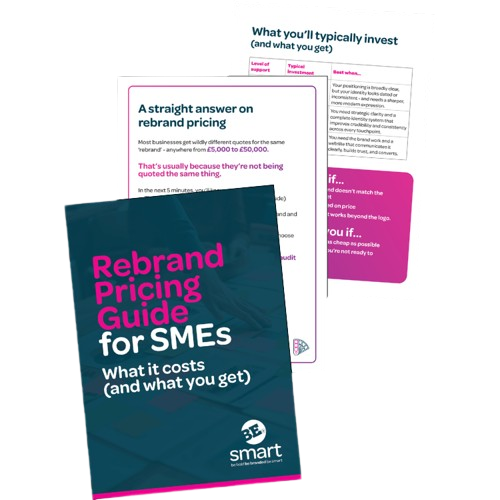
Download the 18-page
Rebrand Pricing Guide
- Real pricing examples
- What drives costs up and down
- How to know if you’re ready
- How to justify a rebrand internally
- Common mistakes businesses make